

The Evolving Commercial Real Estate Landscape
As the commercial real estate industry evolves, businesses must stay informed about trends shaping how and where companies operate. From shifting office demand to growing interest in flexible and mixed-use spaces, the market is presenting new opportunities and challenges for tenants and investors alike. At Heritage Properties, understanding these changes is key to helping businesses make confident real estate decisions. This article will outline some of the key commercial real estate trends businesses should watch out for in 2026.
Flight to Quality In Office Space
Even as hybrid work persists, demand is concentrated on high-quality office buildings with modern amenities, flexible layouts, and transit access. Class A office properties are outperforming older buildings and tenants want amenitized workplaces with areas for collaboration, common areas, wellness features, and better technological integration.
This trend is especially visible in east coast gateway markets like New York, Boston, and Washington, D.C., where modern buildings attract tenants while older office inventory struggles with vacancies.
Office-to-Residential and Mixed-Use Conversions
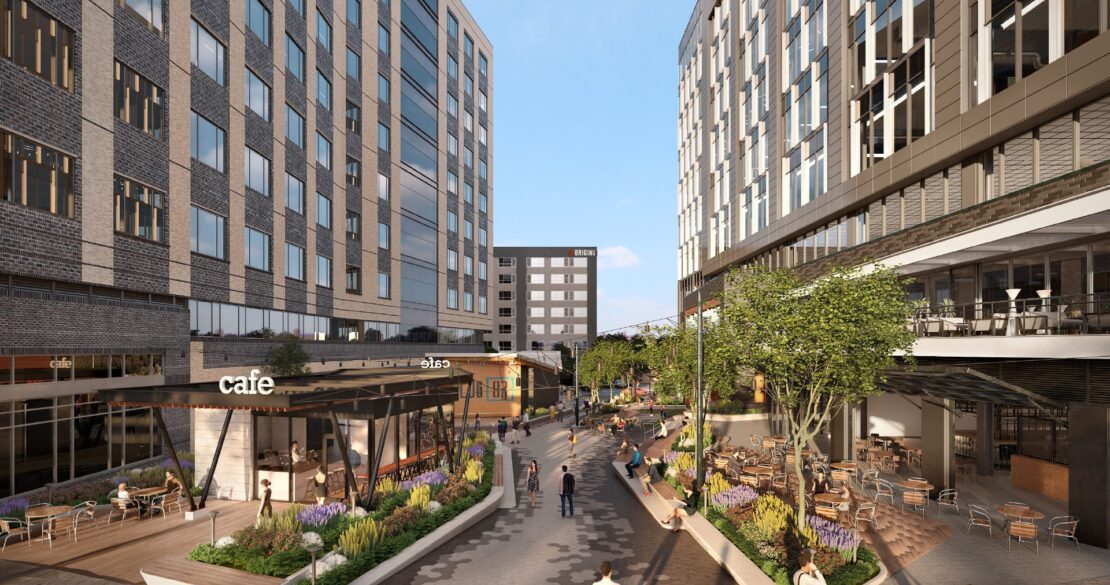
A growing number of underperforming office buildings are being converted to residential or mixed-use developments. Key drivers include persistent office vacancy with the rise of remote work, demand for housing in urban cores, and aging office inventory. For example, several Manhattan office buildings are being repurposed into residential units as office valuations fall.
Industrial Real Estate Is Rebalancing
Industrial and logistics space remains one of the most resilient CRE sectors. In 2026, there may be a leasing demand rebound after a slowdown, with rising absorption projected through 2026. Specifically, there may be increased demand from logistics, manufacturing, and e-commerce.
Industrial space absorption is forecast to reach over 345 million square feet in 2026 as economic conditions stabilize.
On the east coast, strong logistics corridors include the New Jersey/NYC port region, Baltimore/Washington logistics hubs, and Savannah and Charleston port markets.
Flex Space Is Becoming Essential for Small Businesses
Flex space – properties combining office, warehouse, and light industrial uses – is one of the fastest growing niche asset classes. Demand is increasing because small businesses want hybrid workspaces, e-commerce companies need small logistics hubs, and startups require affordable, adaptable space.
Flex space is particularly popular amongst contractors, e-commerce retailers, small manufacturers, and local service businesses. For businesses leasing space, flex properties offer lower costs and operational flexibility compared with traditional office buildings.
Data Centers and AI Infrastructure Are Driving Development
One of the biggest CRE trends is the rapid expansion of data centers. AI adoption is creating massive demand for hyperscale data centers, power-heavy facilities, and land near fiber and transmission infrastructure.
Vacancies in the data center sector remain near historic lows due to limited supply and high power requirements.
CRE Lending Is Gradually Reopening
After several tight years for commercial lending, capital markets are beginning to recover. CRE lending trends in 2026 include increased refinancing activity, along with stabilizing interest rates and rising investment volume. Commercial real estate investment is expected to increase around 16% in 2026, approaching pre-pandemic levels.
However, lenders are still cautious, meaning there will likely be stronger underwriting requirements and higher equity requirements for developments.
Retail Is Stabilizing with Experience-Driven Spaces
Retail real estate has become more resilient than many expected. Growth is strongest in grocery-anchored shopping centers, neighborhood retail centers, and new experiential retail environments. Limited new construction is helping stabilize rents and occupancy levels.
Property Management and Lease Strategy Are Becoming More Complex
With shifting market conditions, commercial property management services and leasing strategies are evolving. Businesses are focusing on shorter lease terms with expansion options and flexible layouts. Professional lease management and data-driven commercial property valuation is also popular. For landlords, strong commercial building management and tenant experience programs are becoming essential to attract and retain tenants.
Key Takeaways For Business Owners
As a result of these shifts, businesses should keep the following takeaways in mind:
- Leasing high-quality office space now may lock in favorable rates before supply tightens.
- Older offices may become redevelopment opportunities or conversion projects.
- Less total office inventory may eventually tighten the leasing supply.
- Mixed-use districts will continue replacing traditional office corridors.
- Companies should secure warehouse and distribution space early.
- Build-to-suit industrial facilities are becoming more common.
- Flex properties will offer lower costs and more operational flexibility compared with traditional office buildings.
- Industrial land and infrastructure-ready sites are becoming increasingly valuable.
- Businesses seeking commercial real estate loans or development financing should plan for longer underwriting timelines
What This Means For Businesses
For businesses evaluating commercial real estate in 2026, the key takeaway is to prioritize flexibility, location quality, and financial readiness. As office demand shifts towards higher-quality buildings and flex space becomes more popular, companies should assess how much room is really needed before leasing commercial office space or retail space.
At the same time, improving conditions for commercial real estate loans mean businesses considering purchasing property should begin preparing for lease agreements early by reviewing commercial loan requirements, securing financing, and conducting thorough commercial property market research.
With changing property values and evolving tenant expectations, working with experienced professionals such as office brokers or industrial brokers, or experts in commercial property appraisal and valuation, can help businesses better understand the commercial property value of potential investments and negotiate smarter leases.
Companies that stay proactive about their real estate strategy will be better positioned to adapt as the CRE market continues evolving across the market.